Picture this: a coastal wind farm in Denmark, turbines spinning steadily under a grey Nordic sky, generating electricity that doesn’t feed into a grid — it feeds into a massive tank of water. That water gets split molecule by molecule into hydrogen and oxygen. The hydrogen gets stored, shipped, and eventually burns clean in a fuel cell halfway across the world. No carbon. No fumes. Just water vapor. That’s not a sci-fi concept anymore — in 2026, it’s a rapidly scaling industrial reality, and it’s worth unpacking exactly how it works and why it matters so much right now.
Renewable-powered water electrolysis — often called green hydrogen production — sits at the intersection of clean electricity and chemical energy storage. If you’ve been hearing the term “hydrogen economy” and wondered whether it’s hype or genuine momentum, let’s think through it together with some hard data and real-world examples.
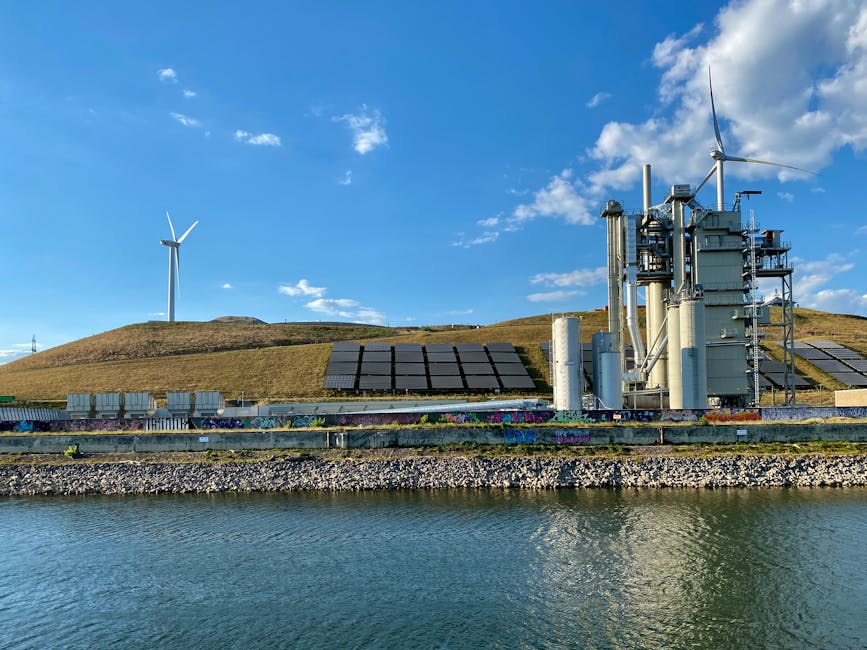
What Is Water Electrolysis, Really?
At its core, electrolysis is beautifully simple chemistry. You pass an electric current through water (H₂O), and it breaks apart into hydrogen (H₂) at the cathode and oxygen (O₂) at the anode. The key equation is:
2H₂O → 2H₂ + O₂
The “green” part comes from where that electricity originates. When you power an electrolyzer with solar or wind energy, the resulting hydrogen carries virtually zero lifecycle carbon emissions — a stark contrast to the dominant “grey hydrogen” produced today via steam methane reforming (SMR), which emits roughly 9–12 kg of CO₂ per kilogram of hydrogen.
The Three Major Electrolyzer Technologies in 2026
Not all electrolyzers are created equal. Here’s where the technology landscape stands today:
- Alkaline Electrolysis (AEL): The oldest and most commercially proven technology. Uses a liquid alkaline solution (typically KOH) as electrolyte. Cost-effective at large scale, but less responsive to fluctuating renewable inputs. System efficiency sits around 63–71%.
- Proton Exchange Membrane Electrolysis (PEM): Uses a solid polymer membrane. Highly responsive to variable power loads — perfect for pairing with intermittent solar or wind. Efficiency ranges from 70–80%, and capital costs have dropped roughly 40% since 2022 due to scaling. This is currently the dominant choice for new green hydrogen projects.
- Solid Oxide Electrolysis (SOEC): Operates at high temperatures (700–900°C), enabling exceptional theoretical efficiencies above 85% when waste heat is available. Still in scale-up phase but gaining traction in industrial settings where heat integration is possible.
The Economics: Where Do We Stand in 2026?
This is where things get genuinely exciting. Green hydrogen’s Achilles heel has always been cost. In 2020, producing 1 kg of green hydrogen cost roughly $4–$6. By mid-2026, benchmark projects in sun-rich and wind-rich regions are hitting $2.10–$2.80/kg, with the most optimized projects in Chile’s Atacama Desert and Australia’s Pilbara region pushing closer to $1.80/kg — approaching the long-held “$2 threshold” that economists consider the tipping point for broad competitiveness with fossil fuels.
Key cost drivers that have shifted the equation include:
- Utility-scale solar LCOE dropping below $0.018/kWh in top-resource regions
- PEM electrolyzer stack costs falling to approximately $450–$600/kW (down from over $1,000/kW in 2021)
- Improved capacity factors through hybrid solar-wind co-location, reducing idle electrolyzer time
- Policy incentives — notably the U.S. Inflation Reduction Act’s $3/kg hydrogen production tax credit (PTC) continuing to drive investment
Real-World Examples Driving the Sector Forward
Theory is one thing — let’s look at what’s actually happening on the ground:
🇰🇷 South Korea – Boryeong Green Hydrogen Hub: South Korea, a country with ambitious hydrogen roadmap targets, has been scaling its Boryeong coastal facility into one of Asia’s largest PEM-based green hydrogen plants. By early 2026, the facility is producing over 3,000 tonnes of green hydrogen annually, feeding directly into hydrogen fuel cell vehicle (FCEV) refueling infrastructure and industrial processes in the Chungcheong region. Korea’s government has backed this with roughly ₩2.1 trillion in cumulative public investment since 2023.
🇪🇺 Europe – HyDeal Ambition & Spanish Solar Corridors: The HyDeal Ambition project, spanning Spain, France, and Germany, has been operationalizing a model where dedicated solar farms in Spain’s La Mancha region power gigawatt-scale electrolyzers. The hydrogen moves via repurposed natural gas pipelines — a clever infrastructure reuse strategy — to industrial consumers in Germany. By Q1 2026, the project corridor is delivering hydrogen at costs competitive with incumbent industrial grey hydrogen on a subsidy-adjusted basis.
🇦🇺 Australia – Asian Renewable Energy Hub (AREH): Western Australia’s AREH remains one of the world’s most watched projects. Combining offshore wind and solar assets totaling over 26 GW of generation capacity, the hub is designed to produce green hydrogen and ammonia for export to Japan, South Korea, and Singapore. The first commercial shipments of green ammonia (a hydrogen carrier) departed in late 2025, marking a genuine proof of concept for the intercontinental green hydrogen trade.
The Realistic Challenges You Shouldn’t Ignore
Let’s be honest — this isn’t a frictionless path. Several genuine bottlenecks remain:
- Water scarcity: Electrolysis requires purified water. Deploying large-scale green hydrogen in arid regions (where solar resources are best) creates real tension with local water availability. Seawater electrolysis R&D is progressing but not yet commercially dominant.
- Storage and transportation: Hydrogen is the smallest molecule — it leaks, it embrittles metal pipelines, and compressing or liquefying it is energy-intensive. Ammonia and liquid organic hydrogen carriers (LOHCs) are viable transport alternatives, each with their own tradeoffs.
- Grid curtailment dependency: Some projects bank on ultra-cheap curtailed renewable electricity. As grids become smarter and storage expands, those hours of near-zero electricity may shrink, affecting project economics.
- Electrolyzer manufacturing bottlenecks: Global PEM electrolyzer production capacity is still ramping up. Lead times for large systems stretched to 18–24 months at peak demand in 2024–2025, though new manufacturing facilities in Europe and East Asia are easing this.
Realistic Alternatives Worth Considering
If full-scale green hydrogen isn’t immediately accessible or economical for your application, here’s how to think through the spectrum of options:
- Blue hydrogen as a bridge: Hydrogen from SMR paired with carbon capture and storage (CCS) — not zero-emission, but significantly lower than grey. Useful for industrial decarbonization where green hydrogen supply is constrained.
- Direct electrification: For many end-uses (heat pumps, EVs, industrial electric arc furnaces), direct use of renewable electricity is more efficient than converting to hydrogen. Only reach for hydrogen where direct electrification genuinely doesn’t work — long-haul shipping, aviation, steel DRI, chemical feedstocks.
- Hydrogen blending: Blending 10–20% green hydrogen into existing natural gas networks is a low-infrastructure-investment way to begin demand creation, though it’s a transitional rather than terminal strategy.
- Power-to-X pathways: Using green hydrogen as a chemical intermediate to produce green methanol, green ammonia, or synthetic fuels (e-fuels) can leverage existing fuel infrastructure while reducing emissions — smart for sectors locked into liquid fuels.
The honest takeaway for 2026 is this: green hydrogen via renewable electrolysis has crossed from “promising experiment” to “real but uneven deployment.” The technology works. The economics are moving in the right direction. But the gap between the best projects and average projects remains wide, and the infrastructure puzzle is genuinely complex. The smart play — whether you’re a policymaker, investor, or industrial operator — is to identify the specific use cases where green hydrogen’s advantages are irreplaceable and build from there, rather than applying it universally.
The water in that Danish tank isn’t just splitting into molecules. It’s splitting apart our old assumptions about what clean energy can actually do.
Editor’s Comment : What strikes me most about the renewable electrolysis story in 2026 isn’t any single technological breakthrough — it’s the compounding effect of incremental improvements across solar costs, electrolyzer manufacturing, and policy frameworks all landing at roughly the same moment. That convergence is rarer than it looks. The projects that will define this decade aren’t the moonshot gigafactories — they’re the mid-scale, carefully sited facilities that nail the basics of resource availability, water access, and off-take agreements. If you’re exploring this space, start by asking “where is renewable electricity cheapest AND most abundant?” — because the electrolyzer is almost the easy part.
📚 관련된 다른 글도 읽어 보세요
- 연료전지 자동차 vs 수소차, 같은 말일까? 2026년 완전 비교 분석
- Can Hydrogen Energy Really Deliver Carbon Neutrality? A 2026 Reality Check
- Hydrogen Fuel Cell Vehicles in 2026: Are We Finally at the Tipping Point?
태그: [‘green hydrogen production 2026’, ‘renewable energy electrolysis’, ‘PEM electrolyzer technology’, ‘water electrolysis hydrogen’, ‘clean hydrogen economy’, ‘hydrogen energy storage’, ‘solar wind hydrogen fuel’]
Leave a Reply