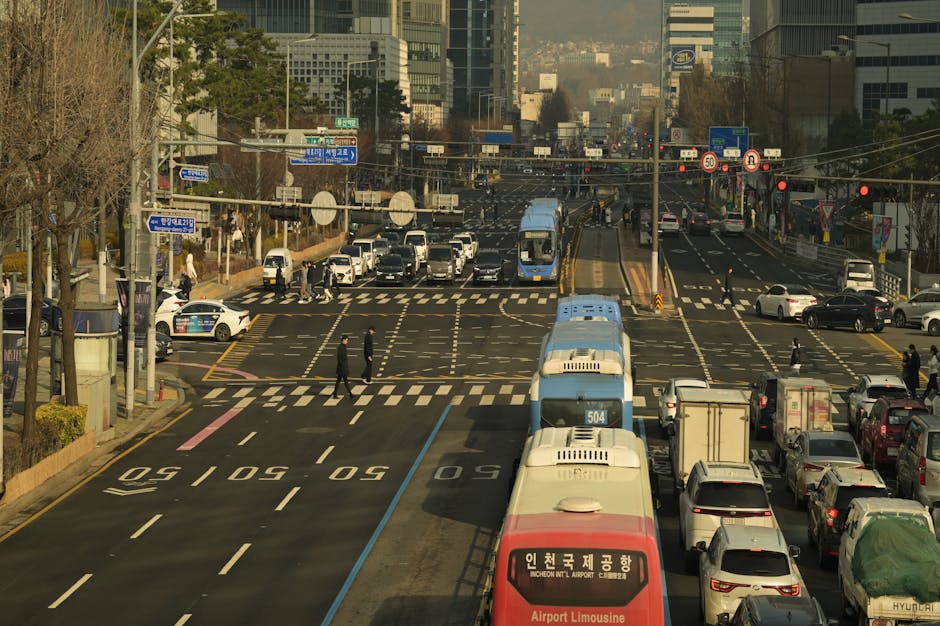
Picture this: it’s a crisp morning in Seoul, and the bus you board smells like nothing — no diesel fumes, no exhaust cloud trailing behind it. The fuel cell humming quietly beneath the floor is powered by hydrogen, and the only byproduct drifting out the tailpipe is water vapor. This isn’t a futuristic fantasy anymore. As of 2026, South Korea is actively engineering this reality at a national scale, backed by one of the most ambitious hydrogen economy roadmaps in the world. But how realistic is it, and what does it actually mean in practice? Let’s think through this together.
The Blueprint: Korea’s Hydrogen Economy Roadmap at a Glance
South Korea’s hydrogen ambitions didn’t materialize overnight. The government’s Hydrogen Economy Roadmap, originally launched in 2019 and significantly updated through 2025 and into 2026, lays out a phased vision with concrete numerical targets. The updated National Hydrogen Basic Plan sets the following milestones:
- Hydrogen vehicle deployment: A target of over 300,000 hydrogen fuel cell vehicles (FCEVs) on Korean roads by the end of this decade, with approximately 95,000 already registered as of early 2026.
- Hydrogen charging infrastructure: Expanding hydrogen refueling stations to over 660 stations nationwide by 2026 — up from fewer than 200 in 2022.
- Green hydrogen production: A commitment to sourcing at least 25% of national hydrogen supply from renewable-powered electrolysis (green hydrogen) by 2030, scaling to 100% by 2050.
- Industrial hydrogen use: Decarbonizing steel, chemicals, and heavy industry by integrating hydrogen as a primary feedstock and heat source.
- Hydrogen power generation: Installing hydrogen and ammonia co-firing capacity in power plants to reduce coal dependency across the grid.
The Money Behind the Mission: Government Investment & Policy Levers
Numbers tell a more compelling story than slogans. The Korean government allocated roughly KRW 4.3 trillion (approximately USD 3.1 billion) in direct hydrogen-related subsidies and R&D investment through the 2025–2026 fiscal cycle. Key policy instruments driving this include:
- Hydrogen Specialty Companies Act (수소전문기업법): Officially enacted, this law grants designated hydrogen companies preferential access to low-interest loans, tax deductions of up to 30%, and streamlined permitting.
- K-Hydrogen Alliance: A public-private consortium including Hyundai Motor Group, POSCO Holdings, SK E&S, and Lotte Chemical, coordinating supply chain development from production to end-use.
- Overseas Hydrogen Import Corridors: Korea has signed bilateral hydrogen supply agreements with Australia, Saudi Arabia, and the UAE, targeting the import of blue and green hydrogen at competitive prices to supplement domestic production limitations.
- Hydrogen Safety & Standards Legislation: The 2024-enacted Hydrogen Safety Management Act is now fully operational, creating unified regulatory standards that reduce compliance ambiguity for businesses entering the space.
Real-World Case Studies: Who’s Actually Making This Work?
Let’s ground this in something tangible. Abstract policy is great, but watching it play out in the real world is where the story gets genuinely interesting.
Domestic: Hyundai’s XCIENT Fuel Cell Trucks in Ulsan
Hyundai’s XCIENT hydrogen fuel cell heavy truck isn’t just a concept — over 50 units are now operating in commercial freight routes between Ulsan’s industrial zones and Busan Port as of 2026. Fleet operators report operating cost parity with diesel trucks when factoring in government fuel subsidies, which is a significant psychological and financial tipping point for logistics companies sitting on the fence.
Domestic: Changwon National Industrial Complex — Korea’s First Hydrogen Special Zone
Changwon has been officially designated a Hydrogen Regulatory-Free Zone, allowing companies to test hydrogen technologies — including building-integrated fuel cells and hydrogen mobility fleets — without the usual multi-year regulatory approval timelines. Think of it as a live sandbox where the future is being debugged in real time.
International Benchmark: Germany’s National Hydrogen Strategy
Germany, which launched its own national hydrogen strategy in 2020 and updated it in 2023, offers an instructive comparison. Germany is investing EUR 9 billion domestically and EUR 2 billion internationally to develop import partnerships. Korea’s approach mirrors this bilateral corridor strategy but adds a sharper focus on FCEV mobility — a segment where Korean manufacturers like Hyundai hold genuine global competitive advantage over German counterparts who lean more heavily toward battery EVs.

The Honest Challenges: What the Roadmap Glosses Over
Here’s where I want us to think critically together, because no roadmap is without friction points.
- Green hydrogen is still expensive: As of 2026, producing green hydrogen via electrolysis in Korea costs roughly USD 5–7 per kilogram — nearly 3x the cost of grey hydrogen (produced from natural gas). Without continued subsidy or dramatic electrolyzer cost drops, the economics remain challenged for mass adoption.
- The “grey hydrogen” transition problem: A significant portion of Korea’s current hydrogen supply is still grey hydrogen, derived from fossil fuels. Calling this a clean energy transition while relying on grey hydrogen is, at best, a half-truth the government acknowledges but hasn’t fully resolved.
- Infrastructure chicken-and-egg: Even with 660+ stations targeted, coverage in rural areas remains sparse. This creates a real hesitancy loop — consumers won’t buy FCEVs if stations are absent, and operators won’t build stations without demand. Government mandates alone can’t resolve consumer psychology.
- International supply chain geopolitical risk: Dependence on hydrogen imports from politically complex regions like the Middle East introduces energy security vulnerabilities Korea is simultaneously trying to escape from oil dependence.
Realistic Alternatives and Parallel Paths Worth Watching
So what’s the smart move if you’re a business, investor, or individual thinking about where hydrogen fits into your own decisions in 2026?
- If you’re a business in heavy industry: Explore hydrogen as a long-term hedge, but don’t abandon near-term electrification wins. Hybrid strategies — electrifying low-temperature processes now, positioning for hydrogen in high-heat applications — are likely the most capital-efficient path.
- If you’re an investor: Look at the electrolyzer and hydrogen storage component supply chain rather than just vehicle manufacturers. Companies like Korea’s Elchemtech and global players entering Korea’s Hydrogen Special Zones represent earlier-stage, higher-upside bets.
- If you’re a consumer considering an FCEV: The Hyundai NEXO remains the most refined FCEV on the Korean market, and government purchase subsidies in 2026 can reduce the effective purchase price by KRW 22.5 million or more depending on region. But check your local refueling station coverage first — that one step makes or breaks the daily-use case.
- If you’re policy-adjacent or in academia: The Changwon and other Hydrogen Special Zones are actively recruiting research partnerships. The regulatory sandbox model is genuinely groundbreaking and worth engaging with directly.
Korea’s hydrogen economy roadmap is one of the most detailed and well-funded national energy strategies in the Asia-Pacific in 2026. It has real momentum, real money, and real industrial muscle behind it. But it also has real gaps — in green hydrogen cost curves, rural infrastructure, and import dependency — that honest observers shouldn’t paper over. The exciting part is that these gaps are well-understood by Korean policymakers and industry alike, which means the solutions being engineered right now are worth watching closely.
Editor’s Comment : Korea’s hydrogen story in 2026 reminds me of where the EV market was around 2015 — fundamentally correct in direction, messier than the brochures suggest, and full of genuine opportunity for those willing to engage with the complexity rather than just the headline. Don’t let either the hype or the skepticism be your only guide. Dig into the specific numbers, visit a Hydrogen Special Zone if you get the chance, and make decisions based on your own sector’s timeline — because the hydrogen transition is happening, just not all at once.
📚 관련된 다른 글도 읽어 보세요
- Liquid Hydrogen Storage & Transport Tech in 2026: What’s Actually Changing Right Now
- 수소 연료전지 상용화 현황 및 전망 2026 — 이제 진짜 시대가 열리는가?
- 재생에너지 기반 수전해 수소 생산 방법 완벽 정리 | 2026년 그린수소 기술 현황
태그: [‘Korea hydrogen economy’, ‘hydrogen roadmap 2026’, ‘South Korea green hydrogen policy’, ‘FCEV hydrogen vehicles Korea’, ‘hydrogen fuel cell investment’, ‘K-hydrogen strategy’, ‘hydrogen energy transition Asia’]
Leave a Reply